What names appear in the new bookmarks?
The bookmarks use source filenames and point to their retained contribution. They are not copies of the original chapter or section outlines.
Join supported PDFs in order and add bookmarks named after the source files. Preview page boundaries before saving the combined document.
No signup · File contents stay on this devicePDF documents · files stay on your device
Up to 20 files · 25 MiB per file · 80 MiB total
Processing happens in your browser. File contents are not uploaded. Close the tab to release active files; temporary handoffs use local browser storage. · Privacy details
Measured with the listed sample and settings; these may differ from this page’s starting preset. Timings are individual processing-function runs in the stated environment and exclude page loading. Library caches may be warm. These small-file checks do not establish performance or compatibility for every document.
| Sample | Settings | Observed output | Environment |
|---|---|---|---|
| sample-document.pdf (3 pages; 2,246 bytes); sample-generated.pdf (2 pages; 238,413 bytes) ↗ | All 5 source pages in original order; new file-name bookmarks | approximately 234.5 KB; 0.02 sec; 5 PDF pages | Chrome · Apple M2 / macOS · 15 Oct 2026 · local test |
Using this tool
Before you start
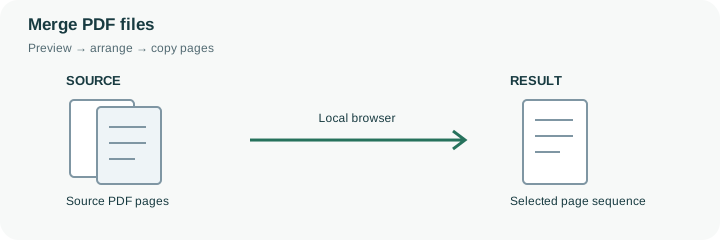
This preset enables new bookmarks named after the source files. When several PDFs form a report packet, those entries help a reader jump to the first retained page contributed by each source. They are simple file-boundary bookmarks, not a reconstruction of the original chapter outline. Give source files understandable names before selecting them if those names will be exposed in the merged document.
Order the files first, then use the page preview to check boundaries and remove an unnecessary cover. If pages from a source are moved, verify where its new bookmark leads in the output. The merger copies supported pages, but original document-level outlines, attachments and complex interactive behavior are outside the guarantee. Files containing encryption, digital signatures or interactive form fields are rejected rather than silently flattened or altered. Keep the source PDFs and open the downloaded merged copy in a reader that shows bookmarks. Check page count, the start of each section and the final page. Combining files is a document assembly step; it does not validate the truth or completeness of the material being assembled.
New bookmark entries use the source filenames and point to the first retained contribution from each file in the selected output order. If every page from a source is omitted, that source contributes no bookmark. These entries describe file boundaries, not the original chapters of a source document.
Reopen the result in a PDF reader with its bookmark panel visible and follow each entry. Reordering pages can make the useful destination different from the source’s original first page. Page copying does not repair cross-document link destinations or carry over every document-level structure. This workflow rejects encrypted, signed and form-bearing PDFs, so use the originals for those features. A merged packet is a new assembly, not a signed or verified replacement for every source.
Common questions
The bookmarks use source filenames and point to their retained contribution. They are not copies of the original chapter or section outlines.
This merger rejects encrypted PDFs, including those you may be able to view with a password. Password-supported rendering is a separate tool and does not preserve document structure.
No. This is page assembly rather than a PDF size optimizer. The final byte size depends on the copied content and new document structure.
No. Page copying and new-PDF creation run locally after the browser loads the required library. The files are not submitted to a server-side merge API.
Yes. Reopen it and check page count, sequence, document boundaries and any newly created bookmarks. A completed merge does not establish that the source packet was complete or correctly ordered.